What are the 10 most common OSHA violations and their deadly impact
Table of Contents
- Understanding OSHA’s Foundational Role in Protecting Workplace Safety
- OSHA’s Regulatory Framework and Enforcement Mechanisms
- OSHA’s Organizational Structure and Global Comparisons
- Industry-Specific Targets and OSHA’s High-Impact Initiatives
- The Top 10 Most Common OSHA Violations: A Detailed Breakdown
- Fall Protection in Construction (1926.501)
- Hazard Communication (HazCom) (1910.1200)
- Scaffolding Violations (1926.451)
- Deep Dive into the #1 Violation: Fall Protection (1926.501) and Its Lethal Consequences
- Scope and Enforcement of OSHA’s Fall Protection Standard
- Three Primary Methods of Fall Protection and Their Design Specifications
- Step-by-Step Procedure for Implementing a Fall Protection Plan
- Hazard Communication (HazCom) and Chemical Safety: Decoding the #2 Violation (1910.1200)
- Evolution of OSHA’s Hazard Communication Standard and GHS Integration
- Six Categories of Hazards Under HazCom and Their Workplace Implications
- Interactive Hazard Classification Table: Labeling, Pictograms, and Precautions
Every year thousands of American workers face life-threatening hazards due to preventable OSHA violations that persist despite clear safety standards. The Occupational Safety and Health Administration enforces regulations designed to protect nearly 130 million workers across industries but still records thousands of citations annually for repeated offenses. These violations range from improper fall protection in construction to hazardous chemical mismanagement in manufacturing where a single oversight can mean fatal consequences. Understanding the most frequently cited violations reveals not just compliance gaps but systemic risks that demand urgent attention from employers and regulators alike.
Behind every OSHA citation lies a story of near-misses and preventable tragedies that could have been avoided with proper training and adherence to safety protocols. The top 10 violations consistently appear year after year because they represent fundamental failures in workplace safety culture rather than isolated incidents. From unguarded machinery to mislabeled chemicals, these violations expose vulnerabilities that cost lives, trigger crippling fines, and erode trust in workplace safety systems. By examining these recurring issues through real-world examples and expert insights, businesses can turn compliance into a competitive advantage while protecting their most valuable asset: their workforce.

Understanding OSHA’s Foundational Role in Protecting Workplace Safety
The Occupational Safety and Health Administration (OSHA) stands as a cornerstone of workplace safety in the United States, established under the Occupational Safety and Health Act of 1970 to prevent injuries, illnesses, and fatalities among workers. Its creation followed decades of unregulated industrial hazards, where an estimated 38 worker deaths per day occurred nationwide before OSHA’s inception. The agency was designed to set and enforce mandatory safety and health standards across industries, ensuring employers provide a workplace free from recognized hazards. With a mission rooted in prevention through education, compliance assistance, and rigorous enforcement, OSHA’s impact extends beyond mere regulation—it reshapes workplace cultures to prioritize safety as a non-negotiable value. OSHA’s authority is grounded in its power to inspect workplaces, issue citations for violations, and impose penalties that can reach $15,625 per serious violation (as of 2023) or $156,259 for willful or repeated violations. The agency operates through a three-tiered enforcement system: complaint investigations (triggered by employee reports), programmed inspections (targeting high-hazard industries), and immediate response inspections (for catastrophes like building collapses or chemical spills). Since its founding, OSHA has conducted over 80,000 inspections annually, with a focus on industries like construction, manufacturing, and healthcare, where workplace injuries are most prevalent. Data from the Bureau of Labor Statistics (BLS) reveals that OSHA’s interventions have contributed to a 60% decline in workplace fatalities since 1970, saving over 13,000 lives annually through improved safety protocols.
OSHA’s Regulatory Framework and Enforcement Mechanisms
 OSHA’s regulatory framework is built on 29 Code of Federal Regulations (CFR) Part 1910, which outlines general industry standards, and Part 1926, specific to construction. These standards cover hazard communication, personal protective equipment (PPE), fall protection, electrical safety, and chemical handling, among others. Enforcement begins with on-site inspections, where OSHA compliance officers assess workplaces for violations. Officers may issue Notices of Non-Compliance for minor infractions or citations for serious hazards, accompanied by proposed penalties. Employers have 15 days to contest citations before the Occupational Safety and Health Review Commission (OSHRC), an independent body that hears appeals and determines penalties.
One of OSHA’s most potent tools is the Severity Weighting System, which assigns penalties based on the gravity of the violation and the employer’s history of compliance. For instance, a willful violation—where an employer knowingly disregards safety laws—can lead to six-figure fines, as seen in cases like Amazon’s 2021 $1.2 million penalty for ignoring machine safety hazards. Additionally, OSHA leverages voluntary protection programs (VPPs) to incentivize exemplary safety records, recognizing Star, Merit, and Demonstration sites that exceed federal standards. These programs reduce inspection frequency for participating employers while fostering industry-wide safety innovation.
OSHA’s regulatory framework is built on 29 Code of Federal Regulations (CFR) Part 1910, which outlines general industry standards, and Part 1926, specific to construction. These standards cover hazard communication, personal protective equipment (PPE), fall protection, electrical safety, and chemical handling, among others. Enforcement begins with on-site inspections, where OSHA compliance officers assess workplaces for violations. Officers may issue Notices of Non-Compliance for minor infractions or citations for serious hazards, accompanied by proposed penalties. Employers have 15 days to contest citations before the Occupational Safety and Health Review Commission (OSHRC), an independent body that hears appeals and determines penalties.
One of OSHA’s most potent tools is the Severity Weighting System, which assigns penalties based on the gravity of the violation and the employer’s history of compliance. For instance, a willful violation—where an employer knowingly disregards safety laws—can lead to six-figure fines, as seen in cases like Amazon’s 2021 $1.2 million penalty for ignoring machine safety hazards. Additionally, OSHA leverages voluntary protection programs (VPPs) to incentivize exemplary safety records, recognizing Star, Merit, and Demonstration sites that exceed federal standards. These programs reduce inspection frequency for participating employers while fostering industry-wide safety innovation.
OSHA’s Organizational Structure and Global Comparisons
OSHA operates through a decentralized network of 10 regional offices and 22 area offices, each tailored to regional industries and workforce demographics. The Washington, D.C.-based headquarters oversees policy development, while state-plan states (like California and New York) administer OSHA-approved programs with enhanced standards. Complementing enforcement, OSHA provides free compliance assistance through On-Site Consultation programs, where safety professionals conduct no-cost workplace evaluations for small businesses. The agency also collaborates with trade unions, industry groups, and academic institutions to refine standards and disseminate best practices. A comparison of OSHA with global counterparts reveals divergences in enforcement rigor and scope. Below is a structured overview of OSHA’s jurisdiction versus international agencies, highlighting key differences in legal authority, inspection frequency, and penalty structures:
| Agency | Country | Legal Authority | Inspection Frequency | Max Penalty (USD) | Unique Features |
|---|---|---|---|---|---|
| OSHA | United States | Federal law (OSH Act 1970) | ~80,000/year (targeted high-risk sectors) | $156,259 (willful violation) | State-plan flexibility; Severity Weighting System |
| Health and Safety Executive (HSE) | United Kingdom | Health and Safety at Work etc. Act 1974 | ~50,000/year (proactive + reactive) | £20M+ (unlimited for corporate manslaughter) | Prosecution for gross negligence; "Duty of Care" principle |
| Safe Work Australia | Australia | State/territory laws (e.g., Work Health & Safety Act 2011) | ~12,000/year (varies by state) | AUD $3M (corporate liability) | Workplace manslaughter laws; industry-specific codes |
| Canadian Centre for Occupational Health and Safety (CCOHS) | Canada | Provincial jurisdiction (e.g., Ontario’s OHSA) | ~5,000/year (provincial variations) | CAD $1.5M (fines per violation) | Internal Responsibility System (IRS); worker participation |
Key Insight: While OSHA operates under federal oversight, agencies like the HSE and Safe Work Australia often prosecute criminal negligence, imposing unlimited fines or even imprisonment for fatal lapses. Conversely, Canada’s provincial model emphasizes worker engagement through mandatory safety committees, a contrast to OSHA’s employer-centric enforcement. These differences underscore how cultural attitudes toward workplace safety shape regulatory approaches, with OSHA’s balance of education and penalties serving as a global benchmark.
Industry-Specific Targets and OSHA’s High-Impact Initiatives
 OSHA’s enforcement priorities shift annually based on workplace fatality trends and emerging hazards. In 2023, the agency prioritized the following sectors due to their high injury/illness rates:
To address these challenges, OSHA launched National Emphasis Programs (NEPs), such as the Silica NEP (2017), which targeted construction and sandblasting industries after studies linked chronic silica exposure to lung cancer. The program resulted in over 2,500 inspections and $10M+ in fines for non-compliance. Similarly, the COVID-
The Top 10 Most Common OSHA Violations: A Detailed Breakdown
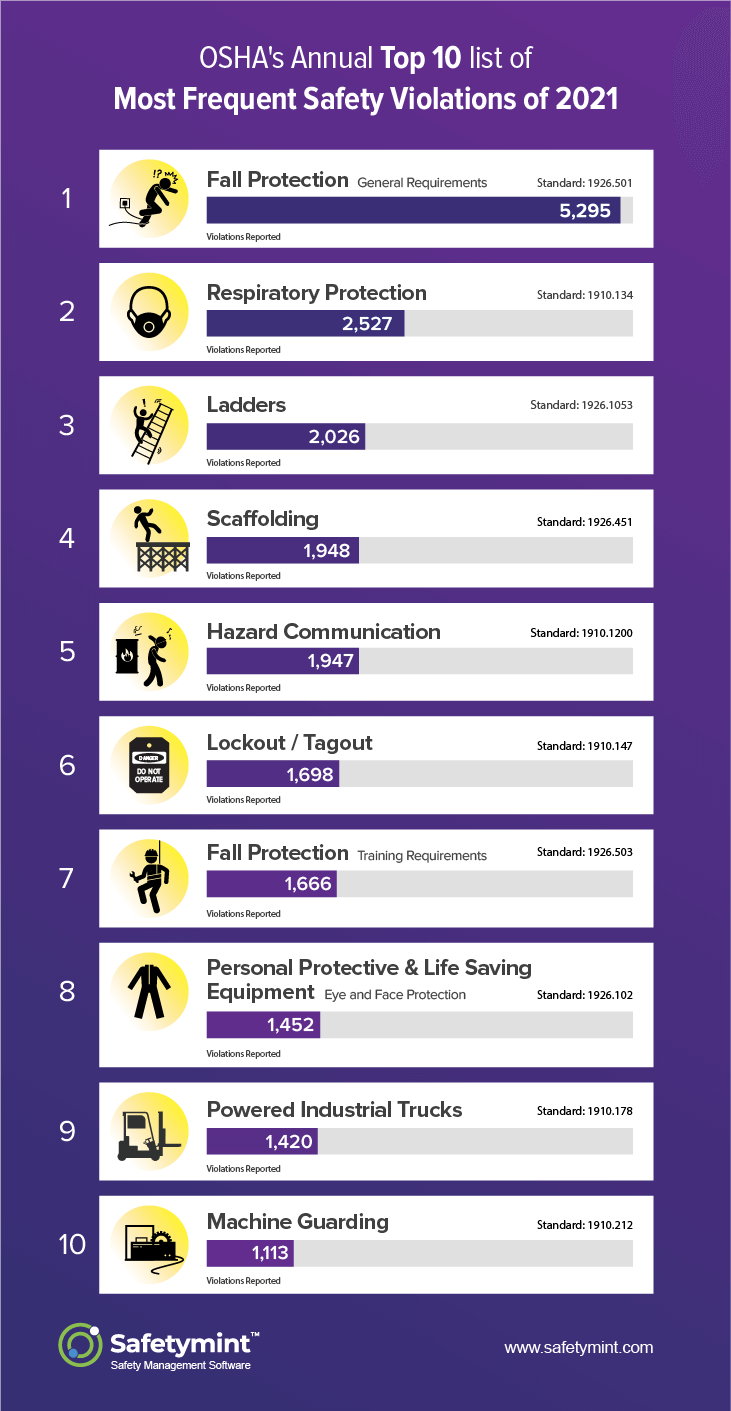
The Occupational Safety and Health Administration (OSHA) enforces workplace safety standards to prevent injuries, illnesses, and fatalities across industries. While employers strive for compliance, certain violations persist due to oversight, lack of training, or inadequate resources. The most recent OSHA data from Fiscal Year 2023 reveals that fall protection, hazard communication, and respiratory protection remain the top concerns. These violations not only pose immediate risks to workers but also result in severe financial penalties, legal repercussions, and long-term reputational damage for businesses. Below is a ranked breakdown of the 10 most frequently cited OSHA violations, their regulatory requirements, real-world implications, and proactive solutions—including technological advancements—that can mitigate these hazards.
Fall Protection in Construction (1926.501)
Fall protection violations dominate OSHA’s citations, accounting for nearly 20% of all construction-related violations in FY 2023. The standard 1926.501 mandates safeguards for workers exposed to falls of six feet or more in general industry or five feet in construction, with stricter rules for unprotected sides and edges. Employers must implement guardrails, safety nets, personal fall arrest systems (PFAS), or other approved systems to prevent falls. Key Requirements and Exceptions:
Real-World Examples and Case Studies: In 2022, a roofing company in Texas faced a $1.2 million fine after OSHA found 15 violations, including lack of fall protection on a 30-foot roof. Workers were observed climbing without harnesses, and the employer failed to provide guardrails or safety nets. The company was ordered to retrain employees, install PFAS systems, and implement a written fall protection plan. Another high-profile case involved a steel erection firm in Ohio, cited for $1.8 million in penalties after a worker fell 25 feet due to missing guardrails. OSHA noted that the employer relied solely on training without enforcing engineering controls like fall arrest systems. Prevention Strategies and Technological Innovations:
Hazard Communication (HazCom) (1910.1200)
The Hazard Communication Standard (HazCom 2012), updated to align with the Globally Harmonized System (GHS), requires employers to identify, evaluate, and communicate chemical hazards to workers. This includes Safety Data Sheets (SDS), labels, and employee training. Violations often stem from missing labels, inadequate training, or failure to update SDS when chemical formulations change. Key Requirements and Exceptions:
Real-World Examples and Case Studies: A manufacturing plant in Illinois was fined $1.5 million in 2023 after OSHA found 30 HazCom violations, including:
The company had relied on verbal instructions instead of documented training, leading to exposure incidents where workers did not recognize corrosive fumes until medical treatment was required. Prevention Strategies and Technological Innovations:
Scaffolding Violations (1926.451)
Scaffolding-related injuries account for hundreds of fatalities annually, with falling objects and structural collapse being the most common hazards. OSHA’s 1926.451 standard requires stable, properly assembled, and inspected scaffolding, with guardrails, toe boards, and fall protection where applicable. Key Requirements and Exceptions:
Real-World Examples and Case Studies: In 2022, a construction firm in California was fined $1.3 million after a scaffolding collapse injured three workers. OSHA investigations revealed:
The employer had purchased a pre-assembled scaffold but failed to verify stability, leading to the collapse during concrete pouring. Prevention Strategies and Technological Innovations:
Deep Dive into the #1 Violation: Fall Protection (1926.501) and Its Lethal Consequences
The Occupational Safety and Health Administration (OSHA) Standard 1926.501 on fall protection remains the most frequently cited violation in construction, reflecting its critical role in preventing fatalities and severe injuries. In 2022 alone, falls accounted for 366 fatalities in the construction industry—a figure that underscores the urgency of compliance. This standard applies broadly to workers in construction, maintenance, roofing, and general industry where unprotected elevations pose imminent risks. The standard mandates specific safeguards to mitigate fall hazards, yet violations persist due to misinterpretation, cost-cutting measures, or inadequate training. Understanding its scope, enforcement triggers, and the mechanics of fall protection systems is essential to reducing workplace fatalities. OSHA’s 1926.501 establishes a hierarchy of controls to address fall hazards, emphasizing engineering controls (e.g., guardrails, safety nets) before relying on administrative or personal protective measures. The standard’s enforcement hinges on height thresholds: workers at six feet or more above a lower level must use fall protection unless other exceptions apply. For example, scaffolding over 10 feet requires fall protection unless it is fully planked with guardrails or a personal fall arrest system (PFAS) is in place. The standard also applies to non-construction industries, such as window cleaning and shipyard operations, where similar risks exist. Non-compliance not only endangers workers but also exposes employers to heavy fines—up to $145,037 per violation for willful or repeat offenses under OSHA’s penalty structure.
Scope and Enforcement of OSHA’s Fall Protection Standard
OSHA’s 1926.501 is designed to protect workers engaged in construction activities, including:
The standard does not apply to:
Enforcement triggers include:
A notable enforcement case involved a roofing contractor in Texas who faced $1.2 million in fines after three workers fell 30 feet due to missing guardrails. OSHA’s investigation revealed no fall protection plan, inadequate training, and rushed job site conditions—common contributing factors in fatal falls.
Three Primary Methods of Fall Protection and Their Design Specifications
OSHA mandates three primary fall protection methods, each with distinct design requirements and limitations. Employers must select systems based on job site conditions, worker mobility, and risk severity. 1. Guardrail Systems Guardrails are the most common and cost-effective solution for permanent or semi-permanent structures. OSHA’s 1926.502(b) specifies:
Limitations:
Example: A window cleaning company in Chicago avoided fatalities after installing temporary guardrails on a high-rise building, complying with 1926.502(b)(1) despite the project’s transient nature. 2. Safety Nets Safety nets are secondary systems used when guardrails or personal fall arrest systems are impractical. OSHA’s 1926.502(g) outlines:
Limitations:
Example: In 2021, a construction site in New York used safety nets beneath a 30-foot-high scaffold, preventing a fall that would have been fatal. However, the nets were not inspected daily, leading to a $75,000 fine for OSHA violations. 3. Personal Fall Arrest Systems (PFAS) PFAS are critical for workers in high-risk or mobile environments, such as steel erection, roofing, or maintenance. OSHA’s 1926.502(d) requires:
Limitations:
Example: A steelworker in Ohio survived a 20-foot fall after his SRL engaged properly, demonstrating the system’s effectiveness. However, another worker in the same crew died when his harness snagged on a sharp edge, highlighting the need for regular equipment checks.
Step-by-Step Procedure for Implementing a Fall Protection Plan
A comprehensive fall protection plan must integrate hazard assessment, equipment selection, training, and ongoing inspections. OSHA’s 1926.503 outlines the six critical steps: 1. Hazard Assessment and Job Site Evaluation Before work begins, employers must:
Example: A roofing contractor in Florida conducted a pre-job hazard assessment and discovered missing guardrails on a 25-foot-high structure. By installing temporary guardrails, they avoided a $150,000 fine and prevented potential injuries. 2. Selection of Fall Protection Methods Choose systems based on:
Table: Fall Protection Method Selection Guide
| Work Scenario | Recommended Protection | OSHA Standard Reference |
|---|---|---|
| Fixed scaffolding (10+ ft) | Guardrails or safety nets | 1926.502(b), 1926.502(g) |
| Roofing or steel erection | PFAS (harness + lanyard) | 1926.502(d) |
| Window cleaning (high-rise) | Positioning systems or PFAS | 1926.502(e) |
| Shipyard maintenance | Safety nets or guardrails | 1915.159 |
3. Equipment Inspection and Maintenance
Hazard Communication (HazCom) and Chemical Safety: Decoding the #2 Violation (1910.1200)
The Hazard Communication Standard (HazCom), codified as 29 CFR 1910.1200, remains one of OSHA’s most critical yet frequently violated regulations, responsible for nearly 800 violations annually in high-risk industries like manufacturing, construction, and healthcare. Since its inception in 1983, HazCom has undergone significant transformations, most notably with its alignment to the Globally Harmonized System (GHS) in 2012, which standardized chemical hazard classification and communication worldwide. This evolution aimed to reduce workplace injuries, illnesses, and fatalities by ensuring consistent labeling, Safety Data Sheets (SDS), and employee training. Despite these advancements, non-compliance persists due to outdated systems, inadequate training, and misinterpretation of hazard classifications. Understanding the six hazard categories, proper labeling protocols, and emerging technologies can mitigate risks and align workplaces with OSHA’s stringent requirements.
Evolution of OSHA’s Hazard Communication Standard and GHS Integration
The original HazCom standard, introduced in 1983, relied on a material safety data sheet (MSDS) format and a hazardous materials identification system (HMIS) that varied by employer, creating confusion and inconsistency. The 2012 revision replaced the outdated system with the GHS, a globally standardized approach adopted by UNECE (United Nations Economic Commission for Europe) to harmonize chemical hazard communication across 73 countries. Key changes included:
The transition to GHS reduced trade barriers and improved workplace safety by providing clear, universally understood symbols. For example, a skull-and-crossbones pictogram now universally signifies acute toxicity, eliminating ambiguity. However, employers often struggle with retrofitting old chemical inventories to comply with GHS, leading to violations under §1910.1200(f)(1) (labeling) and §1910.1200(g)(8) (training).
Six Categories of Hazards Under HazCom and Their Workplace Implications
OSHA’s HazCom standard categorizes hazards into six primary classes, each with specific physical, health, or environmental risks. These classifications determine labeling requirements, protective measures, and employee training needs. Below is a structured breakdown of each category, including real-world examples and OSHA’s enforcement priorities.
Hazard Classification Framework (29 CFR 1910.1200 Appendix A) Hazards are divided into physical, health, and environmental hazards, each with subcategories requiring distinct pictograms, signal words, and precautionary statements.
- Physical Hazards These hazards cause immediate damage through fire, explosion, or reactivity. Examples include:
- Flammable liquids/gases (e.g., acetone, propane) – Require flammability pictograms and storage in explosion-proof containers.
- Oxidizers (e.g., hydrogen peroxide, chlorine) – Demand compatibility checks with other chemicals to prevent violent reactions.
- Corrosive materials (e.g., sulfuric acid, sodium hydroxide) – Mandate acid-resistant storage and neutralization procedures.
- Health Hazards Long-term exposure to these substances can lead to chronic illnesses, organ damage, or carcinogenic effects. Subcategories include:
- Acute toxicity (e.g., hydrofluoric acid, cyanide) – Triggered by single exposure and require immediate medical intervention protocols.
- Carcinogens (e.g., benzene, asbestos) – Linked to cancer development over years; OSHA enforces strict exposure limits (PELs) under §1910.1028.
- Reproductive toxicity (e.g., lead, formaldehyde) – Affects fertility or fetal development; employers must provide PPE and medical surveillance.
- Respiratory sensitizers (e.g., isocyanates in spray paints) – Cause asthma-like symptoms; ventilation systems must comply with §1910.94 (ventilation standards).
- Environmental Hazards These chemicals pose risks to ecosystems or ozone depletion. Key examples:
- Aquatic toxicity (e.g., heavy metals like mercury) – Requires spill containment plans and proper disposal methods.
- Ozone-depleting substances (e.g., CFCs, halons) – Banned under the Montreal Protocol; employers must phase out existing stocks.
Why This Matters Misclassifying hazards—such as labeling a corrosive substance as "irritant"—can lead to OSHA citations under §1910.1200(e)(1) (hazard classification errors). Employers must conduct periodic hazard assessments to ensure accuracy, particularly when introducing new chemicals.
Interactive Hazard Classification Table: Labeling, Pictograms, and Precautions
Below is a collapsible HTML table (descriptive representation) mapping hazard classes to their signal words, pictograms, examples, and required precautions. Employers can use this as a quick-reference guide during chemical inventory reviews.
Note: In practice, this table would be implemented as an expandable/collapsible HTML element with hover tooltips for additional details (e.g., NFPA diamond interpretation).
| Hazard Class | Signal Word | Pictogram | Example Chemicals | Required Precautions |
|---|---|---|---|---|
| Physical Hazards | ||||
| Flammable Liquids | Danger | Flame pictogram | Gasoline, methanol, acetone |
|
| Oxidizing Gases | Danger | Flame over circle | Chlorine, hydrogen peroxide (concentrated) |
|
| Health Hazards | ||||
| Acute Toxicity (Oral) | Danger | Skull and crossbones | Sodium cyanide, strychnine, hydrofluoric acid |
|
| Carcinogens | Warning | Health hazard (exclamation mark) | Benzene, asbestos, formaldehyde |
|
| Reproductive Toxicity | Warning | Health hazard (exclamation mark) | The most common OSHA violations serve as a stark reminder that workplace safety is not just a regulatory obligation but a moral imperative with life-or-death consequences. Fall protection failures alone account for hundreds of fatalities annually, while hazardous chemical mismanagement continues to poison workers and communities alike. The data reveals that these violations are not random acts of negligence but patterns rooted in inadequate training, rushed inspections, and a failure to prioritize safety culture over production quotas. Employers who treat OSHA compliance as a checkbox rather than a continuous improvement process risk catastrophic outcomes that extend beyond legal penalties to shattered lives and damaged reputations. The solution lies in proactive measures—from leveraging technology like AI-driven inspections to implementing rigorous training programs—that transform compliance into a foundation for operational excellence and worker well-being.||
Leave a Comment
Comments are moderated before appearing. The data you submit is processed according to the Privacy Policy of Leveltagrgdpscc.